Football became the world’s game because almost anyone could play it. What happens when access to it (and influence over it) increasingly belongs to those who can pay?
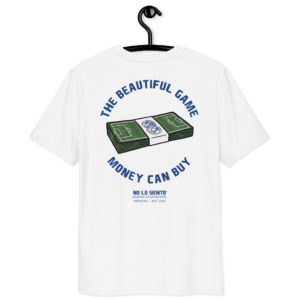
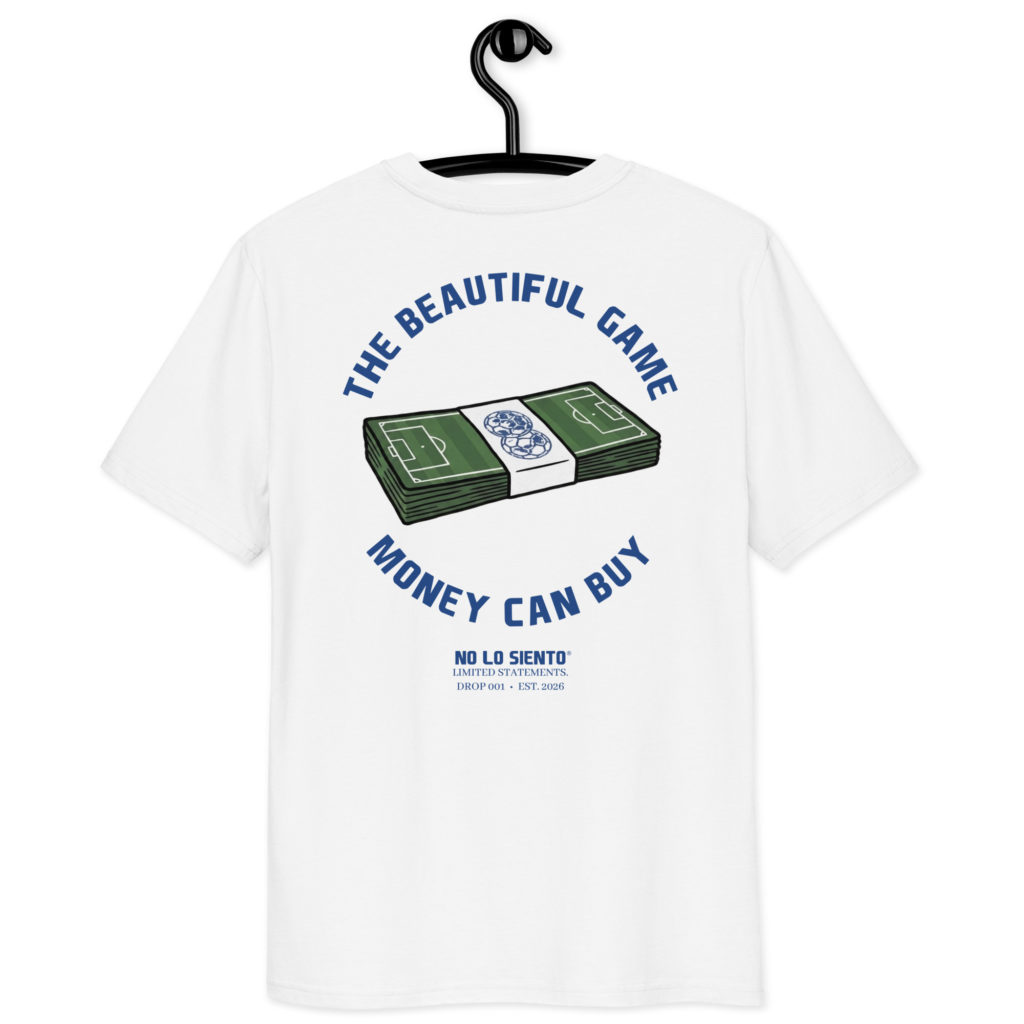
This is not just something to wear. It is a limited statement.
Drop 001 is a visual protest against a game increasingly shaped by money, political access and private influence.
Wear the statement, or keep reading to discover why it exists.
Before Football Had a Price
Before football had executive boxes, broadcast packages, hospitality tiers and investment vehicles, it had a ball.
Sometimes not even a real one.
It had two coats placed on the ground as goalposts. A wall, a street, a yard or a patch of grass. It had children arguing whether the ball had crossed an imaginary line and adults insisting that this time, despite the darkness, the next goal really would be the last.
Football did not begin as a product. It did not require a subscription, a shareholder or permission from a governing body. Its essential promise was almost radically simple: if there was something to kick and enough room to kick it, there could be a game.
Its history is less simple.
No single person invented football. Kicking games appeared independently in different cultures, while forms of folk football were played in Britain for centuries—sometimes so enthusiastically that authorities repeatedly tried to ban them.
The modern game emerged much later, through attempts to reconcile the different rules used by English schools and clubs. In 1863, the Football Association was founded, and Ebenezer Cobb Morley helped draft its first thirteen laws.[1]
Those rules helped standardise football.
But ordinary communities made it matter.
How the People Made It Beautiful
During the late nineteenth century, clubs spread through Britain’s industrial towns and cities. Some grew from churches or workplaces; many were built around neighbourhood identity. Their grounds stood between factories and workers’ homes.
Supporting a club became more than watching a sport. It became a way to belong—to a street, a town, a class, a colour and eventually a story passed from one generation to the next.[2]
British trade, migration and imperial influence carried the codified game around the world. But the world did not simply receive English football. Communities everywhere took it, changed it and made it their own.
It became Brazilian, Nigerian, Argentine, Japanese, Dutch and Moroccan. It became a language spoken in thousands of accents.
That may be football’s greatest achievement.
The rules created a shared game, but the people gave it meaning.
Today, FIFA estimates that football has around five billion fans worldwide.[3] In July 2026, almost 63 million people in the United States alone watched Spain defeat Argentina in the World Cup final. Fox attracted 38.9 million viewers, while Telemundo and Peacock drew another 23.9 million. The equivalent American audience for the 2022 final had been 22.3 million.[4]
Those figures show something beautiful.
A game once played in fields and streets can make entire cities stop, families gather and strangers embrace.
But they also show something valuable.
Popularity Creates Value
Every supporter represents attention.
Every moment of attention can be packaged into broadcasting rights, sponsorships, advertising, hospitality and merchandise. Our devotion is not merely celebrated. It is measured, priced and sold.
Popularity creates money.
Money creates access.
And access, eventually, creates power.
That does not make money inherently evil. Global tournaments cost money. Players deserve to be paid. Stadiums, referees, youth programmes and grassroots facilities require investment.
FIFA argues that the income generated by its competitions is reinvested in developing football worldwide. Through FIFA Forward, member associations receive funding for infrastructure, competitions, women’s football, national teams and grassroots development.[5]
That argument deserves to be taken seriously.
But reinvestment does not erase responsibility.
A governing body cannot claim to serve everyone while treating access to its greatest event as a luxury.
When Belonging Becomes a Luxury
In March 2026, Football Supporters Europe and Euroconsumers filed a formal complaint with the European Commission over FIFA’s World Cup ticketing practices.
They alleged excessive prices, opaque dynamic pricing, pressure-selling tactics and misleading advertising. At the time of the complaint, the cheapest openly available tickets for the final started at $4,185—more than seven times the price of the cheapest ticket for the 2022 final.[6]
Those prices reveal the paradox at the heart of modern football.
The game needs supporters to create its atmosphere, identity and commercial value. But once that value becomes large enough, many of those supporters can no longer afford to be present.
The people make football valuable.
The market then decides which of them may enter.
That is what The Beautiful Game Money Can Buy is about.
It is not nostalgia for a fictional past in which football was completely innocent. Money, gambling, status and influence have surrounded the sport for generations. By the 1930s, football was already being described as something approaching a national industry.[2]
The problem is not that money entered football.
The problem begins when football’s governing institutions stop treating money as a means and start allowing it to shape who receives access, who receives influence and whose questions are considered legitimate.
When Access Becomes Influence
Ownership begins with the right to ask uncomfortable questions.
And one uncomfortable question remains at the centre of the Balogun affair.
Would FIFA have reached the same decision if the person making the phone call had not been the President of the United States?
FIFA did not erase Folarin Balogun’s red card. It suspended the automatic one-match ban for a one-year probationary period, using the discretionary power provided by Article 27 of its Disciplinary Code.
There were precedents for suspending parts of disciplinary sanctions. The decision was therefore not made without any legal basis.
But that does not make the circumstances ordinary.
Donald Trump personally asked Gianni Infantino to review the case. FIFA then granted Balogun an exceptional reprieve, allowing him to play in the United States’ next match. At the time of reporting, FIFA had not published the disciplinary judge’s complete written reasoning.[7]
There is no evidence that Trump ordered FIFA to change the decision. There is no evidence that Infantino instructed the disciplinary body to help the United States. It is possible that the same outcome would have been reached without their conversation.
But that is precisely why transparency matters.
If sporting independence depends on the public simply trusting that a private conversation had no influence, then the safeguards are not strong enough.
FIFA should not merely be independent.
It must be able to demonstrate its independence.
Most supporters cannot telephone the president of FIFA. Most players cannot ask a head of state to intervene. Most national associations do not have direct access to the person at the top of world football.
The question is therefore larger than one red card.
Did Trump’s call change the outcome?
We cannot prove that it did.
Can FIFA prove that it did not?
That answer remains less clear.
Where Friendship Ends and Favour Begins
The Balogun decision did not happen in isolation. It came within a relationship defined by unusually public displays of admiration.
In December 2025, Infantino presented Trump with the inaugural FIFA Peace Prize – Football Unites the World. While giving him the award, Infantino said Trump could count on his support and even on the support of the “entire football community”.[8]
But who authorised him to offer that support on our behalf?
FIFA can create an award. Infantino can express a personal opinion. But neither automatically speaks for every supporter, player, coach, referee and volunteer who makes up the global game.
The choice has become even more difficult to reconcile with the award’s title. By February 2026, Al Jazeera had documented US military action under Trump in at least seven countries—Iran, Venezuela, Nigeria, Somalia, Yemen, Syria and Iraq—as well as strikes on vessels across Latin America and the Caribbean.[9]
Some of those operations occurred after the Peace Prize had been awarded. They cannot retrospectively prove that the original decision was corrupt, nor were all the operations identical in their purpose or legal circumstances.
But they do expose the danger of a football organisation placing itself in the business of politically rewarding world leaders.
What were the published criteria for the prize? Who assessed the candidates? Was there an independent jury? Could the award ever be withdrawn? And when Infantino pledged the support of the football community, which part of that community had been consulted?
Then came another report.
Days after the World Cup final, it was reported that Trump was considering supporting Infantino as a candidate to become the next United Nations Secretary-General.
Neither Trump nor Infantino confirmed a candidacy, and even a formal US nomination would offer no guarantee of success. Infantino would still require the support of the UN Security Council, where any permanent member could block him, before receiving the approval of the General Assembly.[10]
There is no evidence of a deal.
There is no evidence that a World Cup intervention, a FIFA Peace Prize and a possible UN nomination were exchanged as favours between friends.
But public institutions are not judged only by the deals that can be proven behind closed doors. They are also judged by whether their conduct creates a reasonable appearance of mutual advantage.
When one friend can request an exceptional disciplinary review, while the other creates a peace prize for him and is later reported as a possible beneficiary of his political support, why should supporters not ask where friendship ends and favour begins?
Questions are not proof of corruption.
But an institution that demands trust must be willing to answer them.
Football Is Not Separate From Politics
FIFA regularly presents football as a force capable of rising above politics.
The 2026 World Cup showed why that promise is so appealing—and why it is so difficult to maintain.
Iran qualified for a tournament co-hosted by a country with which it was at war. Visa restrictions and political tensions created uncertainty over who would be allowed to enter the United States.
Iran’s planned training base was eventually moved from Tucson, Arizona, to Tijuana, Mexico, with the team required to cross the border for matches in the US.[11]
FIFA did not create US immigration policy. It could not independently issue visas or overrule the government of a host country.
But the consequences were still sporting consequences.
Where a team could sleep, train and recover was shaped by the political decisions of a host government. Officials and supporters faced restrictions that did not apply equally to everyone. Iran participated, but under conditions that demonstrated how international politics could enter the tournament long before the players entered the stadium.
When a team must base itself in one country and travel into another because of the host’s border policy, politics is already influencing football.
This does not mean FIFA could have solved every diplomatic conflict surrounding the tournament. It means that declaring football to be “not about politics” does not make the political influence disappear.
The real test is not whether FIFA can keep politics out entirely.
It is whether FIFA applies transparent standards, protects equal participation and remains willing to challenge powerful hosts when their policies affect teams, officials and supporters.
That is a much harder promise to keep.
Criticism Is Not Hate
After the tournament, Infantino published an open letter defending FIFA’s performance.
He accused critics of spreading false rumours and being “consumed by hate and criticism”. He presented the World Cup as an overwhelmingly safe, joyful and unifying event, pointing to Iran’s participation and arguing that controversial disciplinary decisions were common elsewhere in football.[12]
There was genuine joy.
Millions attended matches and fan festivals. Billions followed the tournament around the world. Families travelled together, strangers celebrated together and supporters created memories that FIFA could never manufacture on its own.
None of that should be denied simply because FIFA deserves scrutiny.
But the joy of supporters does not invalidate questions about ticket prices, visas, refereeing, political access or governance. The success of the football cannot be used as proof that the institution made every decision correctly.
A fact-check by The Athletic examined Infantino’s claims against the public record, including the visa problems, Iran’s disrupted preparations and the unusual handling of Balogun’s suspension.[13]
The record was more complicated than the clean story offered in his letter.
That distinction matters because hate and criticism are not interchangeable.
Hate dehumanises people. It threatens players, officials and supporters because of who they are. FIFA is right to confront that.
Criticism scrutinises decisions. It asks powerful people to explain how authority was used and whose interests were served.
A governing body should be able to distinguish between the two.
Some criticism will be unfair. Some conclusions will be exaggerated. Some allegations will be wrong.
The answer is evidence, not a moral diagnosis of the person asking the question.
When those at the top describe scrutiny as hate, they do not unite the football community. They make accountability sound like an attack.
Football is strong enough to survive difficult questions.
The people governing it should be too.
A Piece of the World Cup
Those questions have now become even more urgent.
FIFA has proposed creating a new subsidiary called FIFA Forward Enterprise, or FFE. The company would combine FIFA’s broadcast, sponsorship, ticketing and licensing rights with the operational delivery of its tournaments.
FIFA intends to value this entity at approximately $20 billion and raise as much as $4.2 billion by selling minority, non-controlling interests to selected long-term investors.
FIFA says it would retain sole control of the company and exclusive authority over football governance, competitions, the match calendar and all sporting and regulatory decisions.[14]
The proposal has a persuasive argument behind it.
FIFA says the new structure would substantially increase the funding available to all 211 member associations. That money could support infrastructure, coaching, grassroots football, national teams and the women’s game—particularly in countries that cannot generate the commercial income available to football’s wealthiest nations.
That deserves serious consideration.
The global game should not exist only to enrich the leagues and countries that are already rich. If FIFA can turn the commercial success of the World Cup into sustainable pitches, coaches and competitions in underserved communities, that is not something to oppose merely because investors are involved.
But FIFA describes this proposal as the “democratisation of football”.
That claim deserves to be tested.
FIFA’s announcement refers to carefully selected investors, not to a public share offering. Nothing announced so far suggests that ordinary supporters will be able to purchase shares.
A prospective investor group is expected to be led by a vehicle founded by Joshua Kushner, the brother of Trump’s son-in-law Jared Kushner.[15]
That connection does not prove improper influence.
It does make full transparency even more important.
Who will be allowed to invest? Who will select them? Will FIFA publish every beneficial owner? What information rights, board representation, vetoes or protections will minority investors receive? Will the complete shareholder agreement be made public? How will conflicts of interest be identified? What happens when an investor wants to sell?
And most importantly: what will those investors expect in return?
A minority shareholding is not the same as control.
But non-controlling does not mean silent, powerless or charitable.
Investors expect returns. Returns require growth. Growth could mean more matches, larger tournaments, new competitions, higher ticket revenues, additional sponsorship inventory or broadcasting schedules designed around the most profitable markets.
There is currently no proof that investors would determine sporting decisions. FIFA has explicitly promised that they would not.
But influence does not always arrive as a formal vote.
It can appear as pressure to meet revenue targets. It can shape which commercial options are presented as realistic. It can change the incentives surrounding tournament expansion, ticket pricing and scheduling without an investor ever selecting a host or writing a rule.
That is why FIFA’s promise to retain formal control is only the beginning of the answer.
UEFA, CONCACAF, the Asian Football Confederation and several national associations have raised concerns about consultation, transparency, governance and potential conflicts of interest. Some said they learned significant details through media reports rather than FIFA’s internal processes.[16]
If organisations already inside football’s governance structure feel excluded from a decision of this magnitude, where does that leave the supporter?
Outside the stadium.
Outside the boardroom.
Outside the ownership structure.
But always inside the business model.
If Ownership Is for Sale, Where Are the Supporters?
Perhaps this proposal creates another possibility.
If FIFA is genuinely willing to sell part of the commercial value created by the World Cup, why should some of that ownership not be reserved for the people who created that value?
Why not supporters?
Why not players’ organisations, grassroots clubs, referees, coaches and community trusts?
A public offering alone would not automatically make FIFA democratic. Wealthier investors could simply buy more shares, recreating the same inequality in a different form.
Meaningful supporter ownership would require protection: capped individual stakes, transparent voting rights, independent fan representation and safeguards preventing shares from quietly accumulating in the hands of corporations, private funds or politically connected billionaires.
Supporters could hold a collective share through independent, democratically governed trusts. Players and grassroots organisations could receive formal representation.
A protected supporter stake could carry rights over issues such as affordability, tournament access, heritage and major changes to competition structures.
The point would not be to turn every fan into a trader.
It would be to recognise that football creates more than financial value—and that the people creating its cultural value deserve a voice when its commercial future is decided.
FIFA says the new company will democratise football by distributing money among member associations.
But democracy is not only the distribution of money.
It is participation in power.
If supporters provide the atmosphere, loyalty, identity, audience and generational memory that make the World Cup worth billions, they should not be treated merely as customers whose role ends after purchasing a ticket or television subscription.
If part of the World Cup is truly for sale, then the public should not simply be offered another product.
We should be offered a seat at the table.
Our Statement
Our Game
That is the statement behind this drop.
The middle finger is not aimed at football.
It is not aimed at players, volunteers or the ordinary people working inside an enormous organisation. It is not an invitation to threaten, harass or hate anyone.
It is aimed upwards—at unchecked power, inaccessible decision-making and the belief that the devotion of billions creates a blank cheque for those governing the game.
The Beautiful Game Money Can Buy is not a claim that football once existed without money. It is not a demand to remove commerce from professional sport. And it is not a declaration that everyone must agree with every argument made here.
It is a protest against money gaining influence without transparency, accountability or meaningful fan representation.
It is a refusal to remain silent while belonging becomes a luxury, political access appears capable of reaching the pitch and part of the World Cup’s commercial future is offered to investors before its supporters are given a meaningful voice.
Ask who decides.
Ask who benefits.
Ask who is allowed into the room—and who is expected to pay from outside it.
Form your own opinion. Challenge this one if you disagree. But do not accept that questioning FIFA means hating football.
We ask these questions because we love football.
Because we remember what made it beautiful.
A ball.
A space.
Two improvised goals.
People who wanted to play.
Football was not made valuable by presidents, governing bodies or investment funds. Its value was built over generations by players, supporters, families, neighbourhoods and communities.
They did not merely consume the game.
They made it.
Football belongs to them.
Football belongs to us.
And no institution should be allowed to sell that belonging to the highest bidder.
THE BEAUTIFUL GAME.
NO LO SIENTO — LIMITED STATEMENTS.
Footnotes
- The Football Association – History of the FA and Goldsmiths, University of London – The history of football.
- Goldsmiths, University of London – From violent peasants to multi-million-pound megastars.
- FIFA – The football landscape.
- Reuters – World Cup final draws record US audience.
- FIFA – FIFA Forward programme and FIFA Forward core principles.
- Reuters – European fans file complaint over World Cup ticket prices and Football Supporters Europe and Euroconsumers – Joint statement.
- Reuters – Trump intervention causes World Cup storm as FIFA clears Balogun and AP – Infantino’s response to the Balogun controversy.
- FIFA – President Donald J. Trump awarded the inaugural FIFA Peace Prize.
- Al Jazeera – What countries has Trump attacked since returning to office?.
- Euronews – Could Gianni Infantino become UN Secretary-General if Trump puts him forward?.
- CNN – Iran’s preparations, visa uncertainty and relocation to Mexico and AP – Iran’s disrupted World Cup preparations.
- FIFA – Gianni Infantino’s post-World Cup message and Reuters – Infantino accuses World Cup critics of spreading hate.
- The Athletic – Fact-checking Gianni Infantino’s World Cup statement, archived version.
- FIFA – Proposal to create FIFA Forward Enterprise and expand development funding.
- Reuters – FIFA plans stake sale through new $20 billion entity.
- Reuters – Confederations and national associations raise concerns over FIFA’s private investment plan.