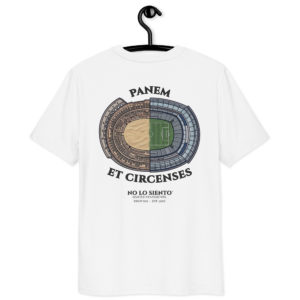
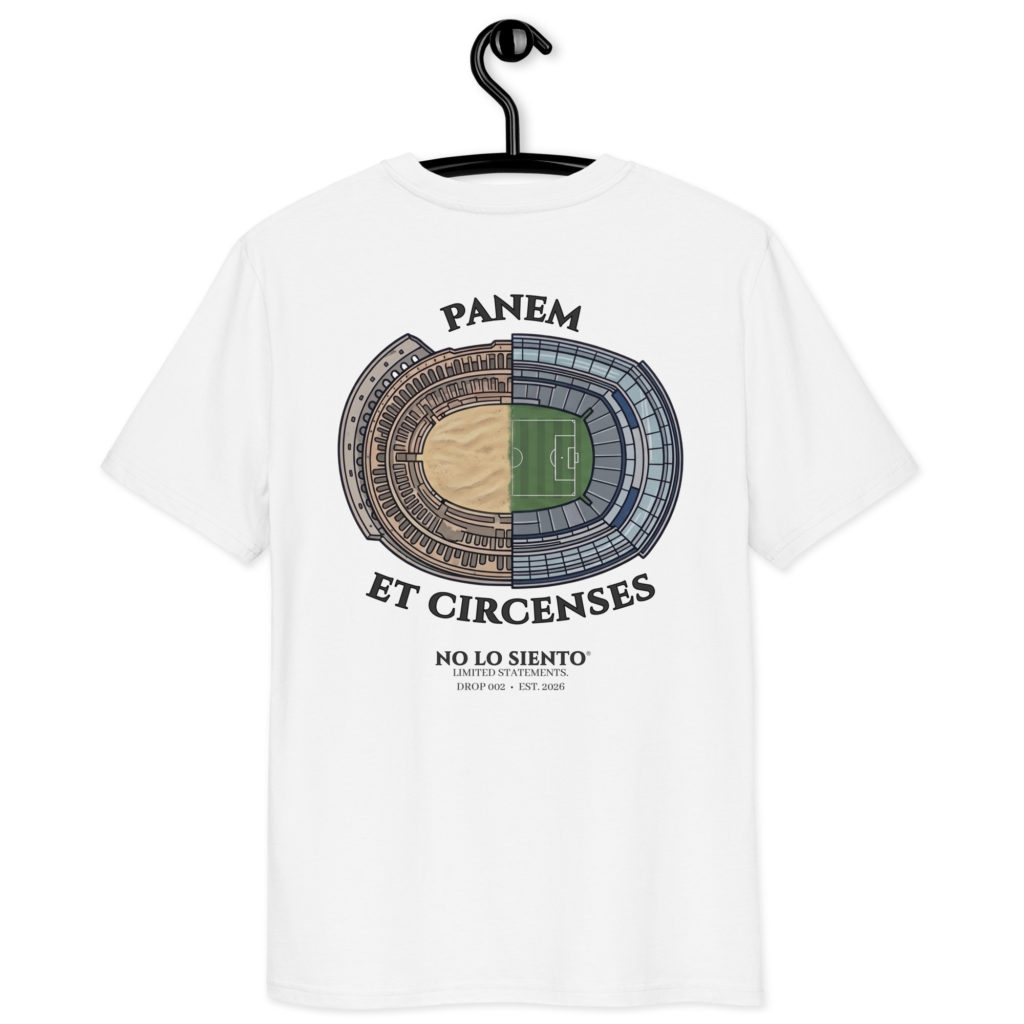
Bread. Games. Closed gates.
This is not just something to wear. It is a limited statement.
DROP_002 is a protest against FIFA, Donald Trump and Gianni Infantino: against an organisation that promised an inclusive World Cup while leaving part of the world outside; against a president who turned its greatest stage into another celebration of his own power; and against the man who placed a peace medal around his neck.
Wear the statement, or keep reading to discover why it exists.
Rome, around the year 100.
The afternoon sun burns against the pale stone. Below, sand clings to sweat and blood. Two bodies circle one another, armed and exhausted, while tens of thousands of voices demand a decisive blow.
Bread passes from hand to hand. Wine spills over the rims of cups. For a moment, nothing exists beyond the arena. No hunger. No corruption. No fear. Only the next strike.
High above the sand sits Juvenal.
Where the crowd sees heroes, he sees a people who have surrendered something. Not in a single day. Not at the point of a sword. Slowly. Vote by vote, concern by concern, until responsibility for the world began to feel heavier than an afternoon of entertainment.
He looks at the cheering mass and thinks of what it once possessed:
The people that once bestowed command, office, legions, everything, now restrain themselves and anxiously long for only two things: bread and circuses.[1]
That is almost certainly not how it happened. We do not know whether Juvenal sat in the Colosseum as the most famous words of his tenth satire took shape. Circenses referred primarily to the circus games, especially chariot racing, rather than gladiatorial combat alone.[1]
But history does not need to repeat itself exactly to become recognisable.
The arena never disappeared.
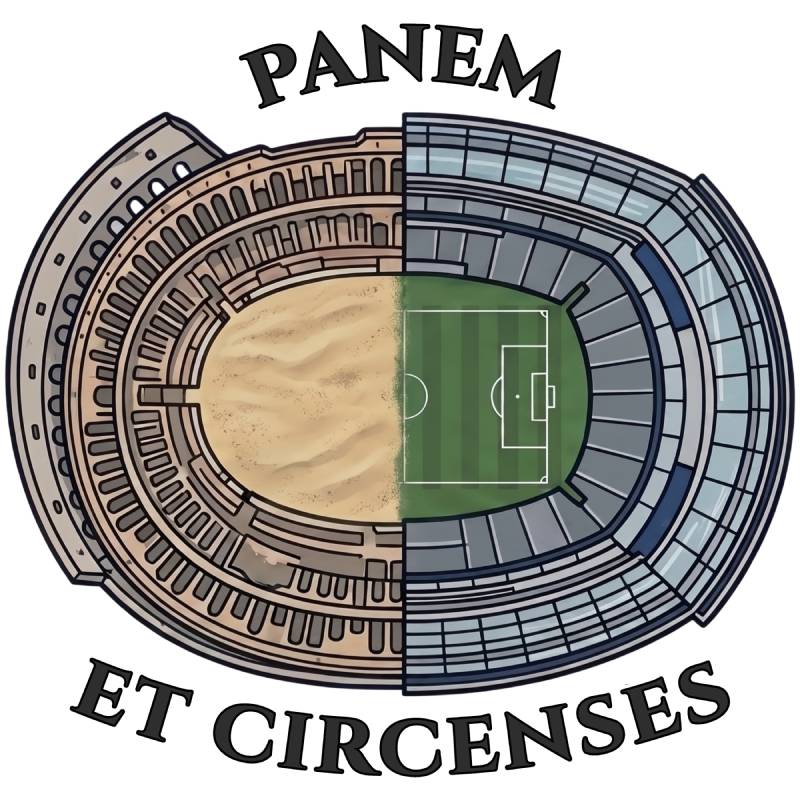
The sand became grass. The sword became a ball. Marble terraces became hospitality boxes, sponsor walls and broadcasting rights. The ruler wears a suit now, and the circus is shown in 4K.
The American centre
In the summer of 2026, Canada, Mexico and the United States staged the largest World Cup in history. Officially, it was a North American tournament. In practice, its political and commercial centre was unmistakably American.
The United States hosted 78 of the 104 matches, including the final.[2] It held most of the stadiums, most of the cameras—and the starring political role.
FIFA sold the tournament as the most inclusive World Cup ever.[3] The world would come together. Football would cross borders. A match ticket would become an invitation to take part in something larger than any one country.
Yet even among the three host nations, the attention was not equal. Canada and Mexico stood beside the United States as co-hosts, but FIFA built its grandest political tribute around Trump alone. Where was the same attention for the leaders of the other two host countries? Where were their peace prizes?
But not everyone made it through the gate.
Welcome to the world. Except you.
Omar Artan was supposed to become the first Somali referee to officiate at a World Cup. He arrived in Miami with a valid visa and the required documents. US authorities denied him entry and sent him back. FIFA then removed him from the tournament.[4]
Iraqi striker Aymen Hussein was detained for almost seven hours while his phone was searched. Team photographer Talal Salah was questioned for more than ten hours and ultimately refused entry. Haiti midfielder Woodensky Pierre received his visa so late that he missed a warm-up match.[4]
Then there was Iran.
All Iranian players eventually received visas, but only ten days before their opening match. Fifteen federation members and several essential support staff were denied them. The team moved its base from Arizona to Tijuana and crossed into the United States for matches under restrictions other teams did not face.[5]
Iran was allowed to play. But not freely, not equally and not without humiliation.
Supporters were left outside too. Fans from several countries reported visas or travel documents being denied or revoked after they had already spent thousands on tickets, flights and accommodation. Rights groups said supporters from countries including Morocco, Egypt, Jordan, Iraq and Uzbekistan were largely absent because of US entry policies.[6]
After the tournament, Jordan Football Association president Ali bin Hussein said Jordanian fans had paid extraordinary ticket prices only to be refused US visas. According to him, FIFA had failed for months to help his association with that and other problems.[7]
Not every case was identical. A delayed visa is not the same as a deportation; detention is not the same as a rejected application. But together, they formed a pattern: a tournament calling itself global while access to it remained conditional, unequal and political.
A World Cup invited the world—and left part of it standing at the border.
The Peace Prize
Before the first ball had even been kicked, FIFA had already made clear who was welcome at the centre of its stage.
On 5 December 2025, during the World Cup draw in Washington, Gianni Infantino presented the inaugural FIFA Peace Prize to Donald Trump. FIFA praised the president’s “tireless efforts to promote peace”. Infantino told Trump that he could count on his support and the support of the football community.[8]
This was not a neutral award. It was not an innocent photograph. The president of world football used the language, spectacle and authority of the sport to legitimise a political leader as a peacemaker.
Trump accepted that role because the spectacle served him. Once again, an institution, a ceremony and a global audience became instruments of his own power and image. The tournament was supposed to be larger than any one country and any one leader. Instead, FIFA helped make him its political protagonist.
The contradiction required no invention.
Since Trump’s return to the White House, the United States had carried out military operations across multiple countries.[9] During the World Cup, it was at war with Iran—the country whose team had been forced to base itself across the border and whose officials had been denied entry.[5]
Yet FIFA placed a peace medal around Trump’s neck.
On 19 July, Trump sat beside Infantino at the final. The pair were booed as they entered the pitch for the trophy ceremony. Then the medals were handed out. The confetti fell. The cameras kept rolling. Trump remained on the podium and presented the trophy.[10]
The protest became part of the show.
Peace existed beneath the stadium lights. The war continued beyond the frame.
FIFA’s alibi
When Infantino was challenged over the visa failures, he said FIFA’s executives were not “kings of the world”. A sports organisation could not overrule governments, border agents or national security policy.[4]
On one narrow point, he was right: FIFA cannot issue an American visa.
But FIFA is not powerless.
FIFA selected the hosts. FIFA’s own bidding rules required visa procedures to be applied without discrimination.[4] FIFA sold the tickets, promised the most inclusive tournament in history and used the image of a united world to generate billions. When that world was not allowed through the gates on equal terms, the organisation hid behind the sovereignty of its host.
FIFA could not stamp a passport. It could choose where to stage its tournament, what guarantees to demand and when to use its immense leverage.
It was not powerless. It was selective about where it used its power.
This is the political argument of DROP_002: under Infantino, FIFA has ceased to behave like an independent sporting organisation and has become a political tool.[14] It spoke of neutrality while choosing which leaders to honour, which conflicts to treat as too complicated and which failures to dismiss. It promised inclusion and fairness, then protected the appearance of both while remaining attached to Trump.
After the World Cup, Ali bin Hussein went further. He accused Infantino of blackmail, alleging that FIFA had suggested its help with Jordan’s problems might depend on his support for Infantino. The accusation remains an accusation, not a proven fact.[7] But it sharpened the central contradiction: an organisation that could do little for excluded supporters appeared capable of finding extraordinary energy when political loyalty was at stake.
Bread and circuses
We do not need to prove that Trump designed the World Cup as a secret distraction. Spectacle does not require written instructions to perform political work.
For ninety minutes at a time, power became entertainment. Policy became background noise. A president whose government closed borders stood at the centre of a tournament that promised to transcend them. A president who used military force received a peace prize. A football organisation that could not guarantee equal access claimed to speak for the entire football community when it offered him its support.
And we watched.
That is why panem et circenses is not merely an accusation from the past. It is a question directed at us.
What are we willing not to see as long as our own seat in the stadium is waiting? How much exclusion will we accept as long as our team is still allowed to play? How easily do we mistake a festive broadcast for a peaceful world?
Bread is no longer only food. It is comfort. The reassurance that our own lives continue: the shop remains open, the screen lights up, the match begins and somebody else pays the price.
The games are not the problem.
The problem begins when the games are enough.
Not against football
DROP_002 is not against football.
Football belonged to people long before it belonged to presidents, federations and sponsors. A pass has no passport. A goal can make millions of strangers rise at the same moment. That is exactly why the game is so useful to power: it can create the image of belonging even while people are being excluded beyond the camera’s frame.
This is a protest against FIFA: an organisation that promised to welcome the world, failed to guarantee equal access and then hid behind the limits of its own authority.
Against Donald Trump: a president who turned a shared international tournament into another platform for his own power, image and supposed peacemaking.
Against Gianni Infantino: a FIFA president who promised inclusion and fairness, failed to deliver either and kept binding the image of world football to Trump. He did not honour Trump despite the reality; he used the spectacle to lift him above it.
And it is a warning to ourselves: if we keep cheering without asking who was not allowed inside, we help the spectacle do its work.
Juvenal did not condemn people for needing bread or loving the games. He saw what disappeared when those things became enough.
Almost two thousand years later, we stand before another arena. The stands are larger. The picture is sharper. The gates are more selective.
Watch the match.
Celebrate the goal.
But do not mistake the stadium for the world.
Ask who was kept outside. Ask why the peace medal stood on the pitch while peace itself was absent. Do not leave your humanity at the entrance.
Football unites the world
In the weeks after the final, Infantino’s authority began to fracture. His proposal to sell a 20 per cent stake in a new commercial entity built around FIFA competitions collapsed after fierce opposition and demands for greater transparency.[11] UEFA and CONCACAF said they had lost confidence in his leadership. Wales withdrew its support for his re-election, and England was set to follow.[12]
The opposition was not universal. Infantino retained support in parts of Africa, Asia and Oceania, and no successor had yet emerged capable of changing the system around him.[13]
Still, Infantino did accomplish one thing.
He promised that football would unite the world. In the end, he united much of the football world against his own politics.
Perhaps that will cost him his re-election. But relief would be premature. We now know whom many want gone. We do not yet know who will replace him, or whether the system that produced him has learned anything at all.
PANEM ET CIRCENSES.
NO LO SIENTO — LIMITED STATEMENTS.
Footnotes
- Juvenal, Satire X, lines 72–81. The English passage in the article is an adapted translation of the Latin text; circenses refers to the public games of the circus.
- FIFA, “How many matches will each country host during the FIFA World Cup 2026?”.
- Reuters, “Inclusive World Cup falls short as some fans shut out, rights groups say”.
- Al Jazeera, “Which World Cup teams, players and officials were denied US visas, entry?”. This source also quotes FIFA’s 2017 non-discrimination requirement for visa processing and Infantino’s “kings of the world” response.
- Reuters, “Iran team chief slams FIFA’s lack of coordination on visa issues”; Al Jazeera, “Which World Cup teams, players and officials were denied US visas, entry?”.
- Reuters, “Inclusive World Cup falls short as some fans shut out, rights groups say”.
- Reuters, “Jordan FA chief accuses FIFA’s Infantino of blackmail over endorsement”. The article explicitly presents the blackmail claim as Ali bin Hussein’s allegation, not as an established fact.
- FIFA, “President Donald J. Trump awarded ‘FIFA Peace Prize – Football Unites the World’”.
- Al Jazeera, “What countries has Trump attacked since returning to office?”.
- Reuters, “Boos as Trump and Infantino enter field for World Cup trophy ceremony”.
- Reuters, “FIFA faces fresh transparency calls after retreat on World Cup sell-off plan”.
- Reuters, “Wales withdraws support for Infantino re-election; England expected to follow”.
- Reuters, “Infantino’s FIFA future in jeopardy after private-equity gamble backfires”.
- Xavier Abu Eid, “FIFA is not an independent sporting organisation; it is a political tool”, Al Jazeera, 11 July 2026. This is an opinion article; it is cited here as context for the political argument made by DROP_002, not as neutral proof of that argument.